Reading Your Home's Water Pressure Symptoms Before Buying a Pump
Before choosing a water pump, it helps to read what your taps, shower and washing machine are already telling you. Here is a calm way to do it.
A simple walk-through of the signs, so the pump you choose answers the real problem
Most people start thinking about a water pump for the house on the day the shower turns into a trickle. That moment is frustrating, but it is also useful. The way water behaves at each tap carries clues about where the weakness comes from, and those clues make it much easier to pick a sensible booster pump instead of guessing.
This guide walks you through the common symptoms, what they usually point to, and what you can note down before you message anyone. None of it needs tools. A phone camera and ten minutes around the house are enough.
Start with a slow tour of the taps
Open each tap one at a time, starting with the one closest to where water enters the house and ending with the highest bathroom. Watch the flow for a few seconds at each point. You are not measuring anything precisely; you are looking for patterns.
Is it weak everywhere, or only in some places?
If every tap is weak, including the kitchen tap downstairs, the supply reaching the house is probably low overall. If the ground floor is fine and only the upper floor struggles, height is the likely factor. Water has to climb, and a gravity-fed upper bathroom often feels the difference first.
Does it change when a second tap opens?
Run the upstairs shower, then ask someone to open the kitchen tap. If the shower drops sharply, the system cannot keep up with two outlets at once. This is one of the clearest situations where a booster pump helps, because the pump is there to hold pressure while several points draw water together.
The common symptoms and what they usually mean
- Weak or slow shower. Often the first sign, especially in upper bathrooms. Check whether the shower head itself is clogged before blaming the supply.
- Washing machine takes a long time to fill. Many machines pause until enough water arrives, so a long fill cycle is a quiet hint of low pressure.
- Pressure drops when two or more taps run. A demand problem: the system copes with one outlet but not several.
- Flow that surges and fades. Uneven flow can come from the supply side or from an existing pump that is struggling.
- Upper floor much weaker than the ground floor. A height problem, common in double-storey terraces and shoplots with living space above.
- Flow suddenly weaker than it used to be. If nothing changed in the house, the cause may be outside, or an existing pump may need attention rather than replacement.
Rule out the small things first
Before you plan a new pump, spend a few minutes on the simple checks. They cost nothing and sometimes solve the issue on their own.
- Unscrew and rinse shower heads and tap aerators. Mineral build-up can make a healthy supply look weak.
- Check that stop valves along the pipe are fully open. A half-closed valve after renovation work is more common than you might think.
- Ask a neighbour whether their pressure has changed. If the whole row is affected, the supply itself may be the reason.
- If you already have a pump, listen to it. A pump that runs constantly, clicks on and off, or makes new noises belongs in a repair conversation, not a replacement one.
Write down what you found
Once you have walked the house, put your notes into a short message. It does not need technical words. Something like "upstairs shower weak, gets worse when the kitchen tap is on, ground floor fine, double-storey terrace" says a great deal. Add a photo of the area where a pump would sit, a photo of your roof tank or incoming pipe if you can reach it, and your location.
How the symptoms lead to a pump suggestion
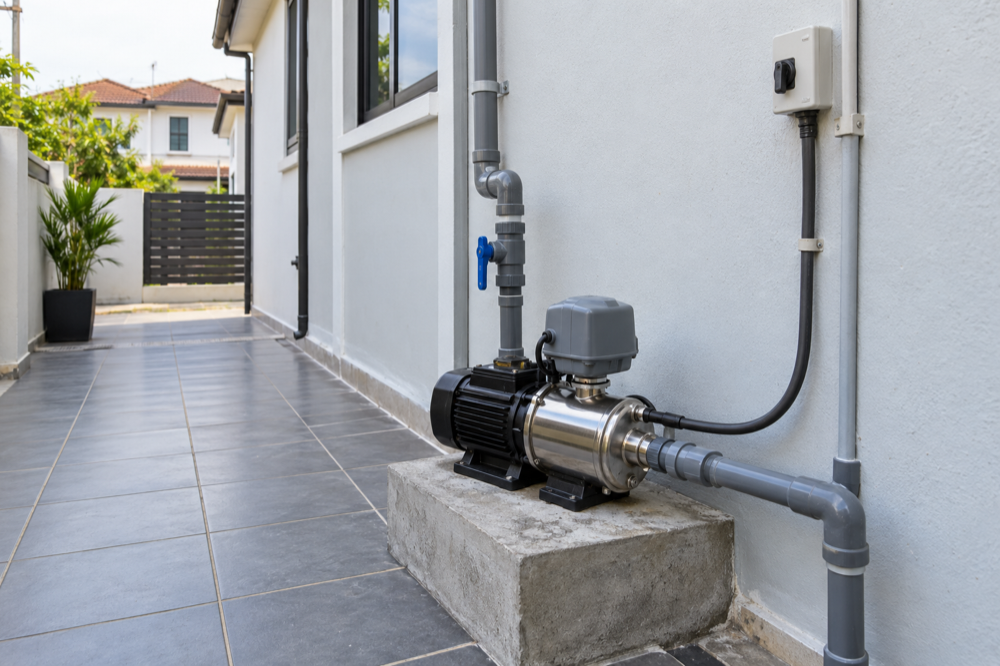
With your notes and photos, we can suggest a horsepower (0.50HP, 0.75HP or 1.00HP) and a brand option. AquaPump Malaysia supplies Tsunami and Grundfos booster pumps. Supply and installation is priced per unit: Tsunami at RM1,800 per unit for 0.50HP, RM2,000 per unit for 0.75HP and RM2,200 per unit for 1.00HP, supply and installation; Grundfos at RM3,600 per unit for 0.50HP, RM3,800 per unit for 0.75HP and RM4,000 per unit for 1.00HP, supply and installation. You can see the full list in our pump catalogue and the side-by-side view in the brand comparison.
Each of these prices covers the pump, installation, basic wiring, and pressure and function testing. Pipe modification, extra wiring and removing an old pump are quoted separately, and we confirm those on WhatsApp before any work starts.
When the symptoms point to repair instead
If you already have a pump and the trouble started recently, repair may be the more sensible first step. Repair is handled by quotation on WhatsApp after we see photos or a short video of the pump running. That way you are not replacing something that only needs a fix.
Wherever you are
We take enquiries from all states, whether you are in Kuala Lumpur, Cheras or Kajang. Scheduling and any extra charges for your location are confirmed on WhatsApp.
Ready to share what you noticed? Send your notes and photos and we will suggest a pump size and price: WhatsApp Us Now.